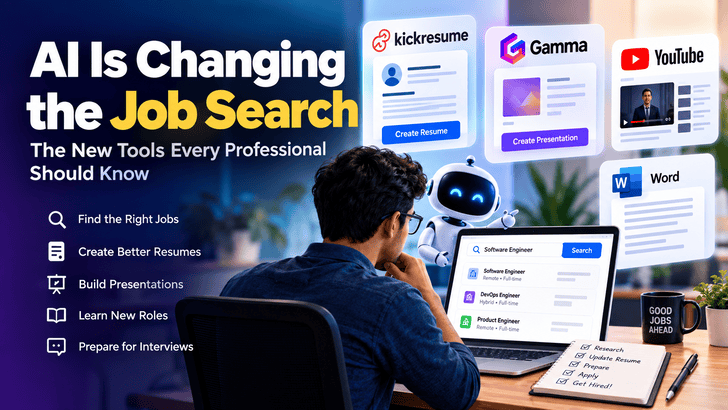
Artificial intelligence isn't just changing how developers write code or how businesses automate repetitive tasks. It is also quietly transforming something almost everyone encounters at some point in their career: finding a job.
The traditional job-search process was fairly predictable. You searched job boards, researched companies, wrote a resume in Word, customized a cover letter, prepared for interviews, and repeated the process.
That workflow still exists—but AI is becoming a new layer across almost every step.
Modern tools can help candidates research opportunities, create tailored resumes, organize information, prepare presentations, and understand unfamiliar roles much faster than before.
But there is an important catch:
AI can accelerate your job search, but it shouldn't replace your judgment or personality.
The Traditional Job Search vs. the AI-Powered Job Search
A few years ago, a typical workflow might have looked like this:
AI Search → AI Research → AI Resume Assistance → Faster Applications → AI Preparation → Human Interview
The biggest change isn't necessarily that entirely new activities have appeared.
Instead, the tools supporting those activities are changing.
A candidate may still need to research a company, understand a position, create a resume, and prepare for an interview. AI simply makes it possible to complete the first version of many of these tasks dramatically faster.
That's an important distinction.
AI isn't eliminating the job-search process.
It is compressing it.
1. AI Resume Tools Are Accelerating the First Draft
Writing a resume from scratch can take hours.
Then comes another challenge: adapting it for a particular opportunity.
AI-powered resume platforms can help candidates get to a useful first draft much faster. One example mentioned in the original discussion is Kickresume.
Instead of staring at a blank page, candidates can use AI to help structure experience, rewrite bullet points, organize skills, and produce an initial version of a resume.
That can be a significant productivity improvement.
But the best workflow isn't:
AI generates resume → Send immediately
A better approach is:
AI generates first draft → You review → You correct → You personalize → You submit
The final steps are where your actual experience and personality enter the document.
2. AI Can Turn Rough Ideas Into Presentable Content
Another interesting part of the new workflow involves presentations.
Tools such as Gamma can help turn rough notes and ideas into structured presentations and documents.
This is particularly useful when a hiring process involves:
Technical case studies
Product proposals
Portfolio presentations
Business analysis
Project summaries
Interview assignments
Traditionally, candidates might spend considerable time deciding how to structure the presentation before even working on the content.
AI can shorten that initial stage.
Give the system your notes and requirements, and it can help organize the information into a logical starting point.
The candidate can then focus on the higher-value questions:
Is the argument convincing?
Is the information correct?
Does this actually represent how I think?
Those questions still require human judgment.
3. Job Search Is Becoming More Conversational
Traditional job search engines are built around keywords and filters.
You might search:
Backend Developer Node.js Remote
AI introduces a different interaction model.
Instead of figuring out the perfect search keywords, users can increasingly describe what they actually want:
Find roles suitable for a backend developer with Node.js and AWS experience who wants to move toward platform engineering.
That shift from keyword search to conversational discovery could become one of the most important changes in online recruitment.
Traditional platforms such as Indeed remain extremely useful, but AI-assisted discovery can complement them by helping candidates understand roles and refine what they're searching for.
The future probably isn't simply "AI replaces job boards."
It is more likely:
AI becomes an intelligent layer around job boards, company career pages, professional networks, and other sources.
4. YouTube Still Solves a Problem AI Can't Completely Replace
Interestingly, AI doesn't make every traditional tool obsolete.
YouTube remains extremely useful when researching unfamiliar careers.
Suppose you're a software engineer considering a transition into DevOps.
An AI assistant can quickly explain:
What DevOps engineers do
Common tools
Typical responsibilities
Required skills
Possible career paths
That's useful.
But watching an experienced DevOps engineer explain what their actual working day looks like gives you something different.
You hear about production incidents.
You hear about frustrating meetings.
You learn what responsibilities consume the most time.
You discover which parts of the job people enjoy—and which parts they don't.
AI is excellent at summarizing information.
First-hand experience provides context.
The strongest research process often uses both.
5. Microsoft Word Isn't Dead Either
For decades, Microsoft Word has been one of the default tools for resumes, cover letters, and professional documents.
AI resume builders aren't necessarily going to eliminate it.
Candidates may use an AI platform to create the initial content and then move into a familiar document editor for final adjustments.
That illustrates a broader pattern we're seeing with AI.
New tools don't always replace old tools.
Sometimes they simply change which part of the workflow each tool handles.
AI might generate.
Word might edit.
A job board might discover opportunities.
YouTube might provide real-world context.
LinkedIn might provide professional connections.
The modern workflow is increasingly a combination of specialized tools.
The Biggest Risk: Everyone Starts Sounding the Same
There is also a downside to AI-assisted applications.
Imagine 500 candidates applying for the same position.
Every candidate feeds the same job description into an AI assistant.
Every candidate asks:
"Optimize my resume for this job."
The systems identify similar keywords.
They recommend similar skills.
They produce similar professional language.
Suddenly, hundreds of applications begin to sound remarkably alike.
This concern also appeared in the discussion around the original LinkedIn post, where commenters questioned overly optimized resumes and warned that candidates risk losing the individual signals that help them stand out.
This creates an interesting paradox:
The easier AI makes personalization, the less meaningful generic AI personalization becomes.
Don't Optimize Your Personality Out of Your Resume
Your resume should obviously communicate why you're qualified.
But it also needs to accurately represent you.
Consider two approaches.
Version A
Results-driven software engineer leveraging cutting-edge technologies to deliver scalable and innovative solutions.
It sounds professional.
It also sounds like thousands of other resumes.
Version B
Backend engineer focused on Node.js and distributed systems. Recently reduced API response times by 38% by redesigning our caching strategy.
The second version contains something far more valuable:
specific evidence.
AI can help improve the sentence.
It cannot invent credible professional experience that you don't have.
Your real projects, decisions, mistakes, achievements, and lessons are still your strongest differentiators.
The Best AI Job-Search Workflow
Instead of asking whether you should use AI when searching for jobs, ask a better question:
Where should AI be used, and where should I take control?
A practical workflow might look like this:
Step 1: Discover
Use job platforms, professional networks, company career pages, and AI-assisted search to discover opportunities.
Step 2: Research
Ask AI to explain unfamiliar technologies, industries, companies, and job responsibilities.
Then validate important information through company websites, documentation, employee experiences, videos, and other primary sources.
Step 3: Draft
Use AI to help produce an initial resume, cover letter, presentation, or application response.
Step 4: Verify
Check every claim.
Never allow an AI-generated document to exaggerate skills or invent experience.
Step 5: Personalize
Add concrete examples from your career.
Replace generic language with measurable results and specific experiences.
Step 6: Prepare
Use AI to generate possible interview questions, explain technical concepts, or simulate interview scenarios.
Step 7: Be Human
When the actual conversation happens, don't try to sound like an AI-generated "perfect candidate."
Explain how you think.
Talk about real projects.
Admit what you don't know.
Describe how you solve problems.
That's where differentiation happens.
AI Should Handle the Blank Page
One of AI's greatest productivity advantages is removing the difficulty of starting from nothing.
A blank resume is difficult.
A blank presentation is difficult.
A blank cover letter is difficult.
A blank interview preparation document is difficult.
AI can transform that blank page into a starting point within seconds.
From there, human judgment becomes much more valuable.
This leads to a useful principle:
Let AI create the first 70%. Spend your effort making the final 30% unmistakably yours.
The exact percentage doesn't matter.
The philosophy does.
Use machines for speed.
Use humans for judgment.
The Future of Job Hunting Is Human + AI
We're moving away from the question:
"Should I use AI for my job search?"
Soon, using some form of AI assistance may be as normal as using a search engine, spell checker, or resume template.
The more important question will become:
"Am I using AI in a way that actually improves my application?"
The strongest candidates won't necessarily be those who avoid AI.
And they probably won't be the candidates who allow AI to do everything.
They'll be the people who understand the strengths of both sides.
AI is good at speed, structure, summarization, brainstorming, and first drafts.
Humans remain essential for experience, context, judgment, credibility, personality, and trust.
That combination is where the real advantage lies.
Final Thoughts
The job-search workflow is changing quickly.
AI resume builders can accelerate writing. AI-powered tools can structure presentations. Conversational assistants can help candidates understand unfamiliar roles. Traditional platforms still provide opportunities, while videos and first-hand experiences provide context AI summaries cannot fully capture.
But technology doesn't change the fundamental goal of hiring.
Behind every resume is a person.
And behind most hiring decisions is another person trying to determine:
Can I trust this candidate to do the job?
Use AI to research faster.
Use it to draft faster.
Use it to prepare better.
But when the final application leaves your hands, make sure it still sounds like you.
Because when everyone has access to the same AI tools, authenticity may become one of the most valuable competitive advantages left.