Large Language Models are incredibly powerful, but they have an important limitation: they do not automatically know everything about your organization, your private documents, your customers, or information that appeared after their training.
Imagine building an AI assistant for a company.
You might want it to answer questions about:
Internal documentation
Product manuals
Company policies
Customer information
Technical documentation
Source code
Research papers
Frequently changing business data
How should that information reach the AI model?
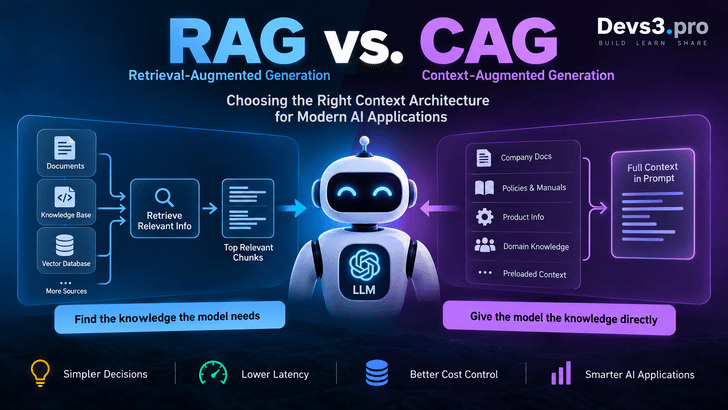
For the past several years, one of the most popular answers has been Retrieval-Augmented Generation (RAG).
But RAG is not always necessary.
As context windows have grown and prompt caching and context-management techniques have improved, another architectural pattern has become increasingly practical: providing the required knowledge directly within the model's context.
This approach is often described as Context-Augmented Generation (CAG) or, depending on the implementation, long-context generation.
The fundamental difference is surprisingly simple:
RAG retrieves the information it thinks the model needs.
CAG gives the model the relevant information as context without performing retrieval for every question.
Understanding when to use each approach can dramatically simplify AI architecture, reduce latency, control costs, and improve answer quality.
The Real Problem: Giving an LLM the Right Knowledge
A Large Language Model generates answers based on the information available to it during inference.
For application developers, the challenge therefore isn't simply:
"Which LLM should we use?"
An equally important question is:
"What information should the LLM receive before generating an answer?"
This is becoming known as context engineering.
A good AI system does not necessarily give the model the maximum possible amount of information. Instead, it attempts to provide the smallest set of high-quality, relevant information needed to perform the task correctly.
RAG and CAG represent two different strategies for solving that problem.
What Is Retrieval-Augmented Generation (RAG)?
Retrieval-Augmented Generation connects an LLM to an external knowledge source.
Instead of sending an entire knowledge base to the model, the system searches the knowledge base and retrieves information relevant to the user's question.
A simplified RAG pipeline looks like this:
User Question
↓
Query Processing
↓
Search / Retrieval
↓
Relevant Documents or Chunks
↓
Add Retrieved Information to Prompt
↓
LLM
↓
Generated Answer
Suppose a company has 100,000 technical documents.
A user asks:
"How do I reset Model X200 after firmware version 4.2?"
Sending all 100,000 documents to the LLM would obviously be impractical.
A RAG system instead searches the knowledge base and might retrieve five highly relevant sections.
Those sections are added to the model's context, and the LLM generates its answer using them.
This ability to combine parametric model knowledge with external, non-parametric knowledge is the foundation of RAG.
How a Typical RAG System Works
Modern RAG systems usually have two major stages.
Stage 1: Indexing
Before users start asking questions, documents are prepared for retrieval.
A common pipeline is:
Documents
↓
Parsing
↓
Chunking
↓
Embedding Generation
↓
Vector Database / Search Index
Documents are usually divided into smaller pieces called chunks.
For example:
A 100-page PDF might become hundreds of chunks.
An embedding model then converts each chunk into a numerical representation describing its semantic meaning.
Those embeddings can be stored in systems such as:
pgvector
Pinecone
Weaviate
Milvus
Qdrant
Elasticsearch
OpenSearch
The exact infrastructure depends on scale and requirements.
Stage 2: Retrieval and Generation
When a user asks a question:
Question
↓
Query Embedding
↓
Vector / Keyword / Hybrid Search
↓
Top Relevant Chunks
↓
Optional Reranking
↓
Prompt Construction
↓
LLM Generation
Instead of processing the entire knowledge base, the LLM sees only a relatively small collection of relevant information.
That is RAG's biggest advantage.
Why RAG Became So Popular
RAG solves several major problems associated with LLM applications.
Large Knowledge Bases
The external dataset can be much larger than the model's context window.
Millions of pages can theoretically be searchable while only a handful of relevant passages are passed to the LLM.
Frequently Changing Information
The underlying knowledge can change without retraining the model.
Update the database or search index, and future retrieval can use the new information.
Private Organizational Knowledge
Companies can connect LLMs to internal documents, support articles, product databases, and other proprietary information.
Lower Context Usage
Only relevant documents need to be included in each request.
Source Attribution
Because documents are explicitly retrieved, applications can often show which sources contributed to an answer.
But RAG Introduces Another Problem: Retrieval
RAG sounds straightforward:
Find relevant information and give it to the model.
In reality, finding the correct information is often the hardest part.
Imagine a document contains this sentence:
"The company's revenue increased by 17%."
After chunking, that sentence might lose important surrounding information.
Which company?
Which quarter?
Compared with what period?
Which currency?
A semantic search engine may therefore fail to retrieve it for the correct question.
This is one reason production RAG systems often become much more complicated than the simple architecture shown in tutorials.
Developers may eventually introduce:
Better chunking
Metadata filtering
Hybrid search
BM25
Query rewriting
Reranking
Contextual embeddings
Document summaries
Multiple retrieval stages
Knowledge graphs
Agentic retrieval
The retrieval layer can become an entire system of its own.
What Is Context-Augmented Generation (CAG)?
Context-Augmented Generation takes a different approach.
Instead of searching a knowledge base for every query, the application prepares relevant knowledge and supplies it directly to the LLM's context.
Conceptually:
Knowledge
↓
Prepare / Structure Context
↓
LLM Context
↓
User Question
↓
LLM
↓
Answer
There is no mandatory vector search step between the user's question and the model.
The model already has access to the information it needs.
A useful mental model is:
RAG = Retrieve what you need.
CAG = Provide what you need.
This distinction was also the central architectural idea highlighted by the LinkedIn discussion that inspired this article.
A Simple CAG Example
Imagine an AI assistant used by a small company.
Its knowledge consists of:
A 20-page employee handbook
15 pages of product information
A 10-page FAQ
Several pages of company policies
The entire useful knowledge base might comfortably fit inside the model's available context.
You could build a vector database, create embeddings, tune chunk sizes, configure retrieval, and maintain an indexing pipeline.
But you may not need any of that.
Instead, you could provide the relevant knowledge directly as context.
The architecture becomes:
Company Knowledge
↓
Cached / Prepared Context
↓
User Question
↓
LLM
↓
Answer
For the right use case, this can be dramatically simpler.
RAG vs. CAG: The Architectural Difference
Area
RAG
CAG
Knowledge access
Retrieved dynamically
Provided/preloaded as context
Best knowledge size
Large
Small to moderate
Frequently changing data
Excellent fit
Requires context refresh
Retrieval infrastructure
Usually required
Often unnecessary
Vector database
Common
Usually not required
Embeddings
Common
Not inherently required
Retrieval errors
Possible
No retrieval miss if information is already present
Context usage
Selective
Potentially larger
Architecture
More components
Potentially simpler
Scaling to huge corpora
Strong
Limited by practical context constraints
Query-time search
Yes
Usually no
Implementation complexity
Moderate to high
Low to moderate
Neither architecture is universally better.
The right choice depends on the characteristics of the knowledge.
The Most Important Decision: How Much Knowledge Do You Have?
Knowledge size is one of the clearest architectural signals.
Suppose your application uses:
50 pages of stable documentation.
Direct context may work extremely well.
Now imagine:
5 million documents across hundreds of gigabytes.
Passing everything to the model is impossible and unnecessary.
Retrieval becomes essential.
The decision can therefore often begin with:
Can the useful knowledge comfortably fit into the model's practical context budget?
If yes, test a context-based architecture.
If no, retrieval becomes increasingly attractive.
Context Window Size Does Not Tell the Whole Story
Modern models can process increasingly large contexts.
This has led some developers to assume:
"If everything technically fits, just send everything."
That isn't always a good idea.
Context is not free.
Large contexts can affect:
Token cost
Latency
Attention
Information relevance
Output consistency
Application scalability
The model may technically accept a huge document while still performing better when given a smaller, carefully curated collection of relevant information.
Therefore, context engineering isn't about maximizing tokens.
It is about maximizing useful information per token.
The "Lost in Context" Problem
More context does not automatically mean better reasoning.
Imagine asking someone to find one important sentence inside a stack of thousands of pages.
The answer is technically available, but locating and interpreting it becomes harder.
LLMs can face a similar problem.
As irrelevant information increases, important signals may compete for attention.
This means CAG works best when the supplied context is:
Relevant
Well structured
Relatively stable
Reasonably sized
Clearly separated
Easy for the model to navigate
Dumping random documents into a massive prompt is not good context engineering.
Where CAG Can Be Excellent
CAG can be especially attractive for applications such as:
Small Documentation Assistants
A product with a relatively compact manual or FAQ.
Internal Policy Bots
Organizations with limited sets of HR, compliance, or operational policies.
Specialized AI Assistants
Applications where a fixed collection of domain instructions defines behavior.
Configuration Assistants
AI systems working with a known configuration, schema, API specification, or structured reference.
Short Research Collections
Applications analyzing a limited collection of reports or papers.
Session-Specific Documents
A user uploads several documents and asks multiple questions about those same documents.
Instead of repeatedly searching them, the application may maintain the relevant material in context.
Where RAG Clearly Becomes More Attractive
RAG is usually the stronger architecture when knowledge becomes too large or dynamic for direct context.
Examples include:
Enterprise Search
Millions of internal documents.
Customer Support Platforms
Thousands or millions of constantly updated help articles and support records.
E-commerce
Huge catalogs containing frequently changing products, specifications, inventory, and prices.
Legal Research
Massive collections of legislation, judgments, contracts, and legal documents.
Financial Intelligence
Large quantities of filings, reports, research, and continuously changing information.
News Applications
Information changes continuously and freshness is critical.
Large Codebases
Retrieval can identify the files, functions, or documentation relevant to a developer's question.
The Cost Question
It may appear that CAG must always be expensive because it sends more tokens.
That is not necessarily true.
The actual economics depend on:
Model pricing
Input token volume
Number of requests
Retrieval infrastructure cost
Embedding cost
Database cost
Prompt caching
Cache hit rate
Application traffic
Prompt caching can significantly change the calculation.
If a large portion of context remains identical between requests, some model platforms can reuse cached prompt content rather than repeatedly processing everything at full cost.
This can make long-context architectures much more practical for stable knowledge.
The Latency Question
RAG adds steps before generation.
For example:
User Query
→ Query rewriting
→ Embedding
→ Vector search
→ Keyword search
→ Metadata filtering
→ Reranking
→ Context construction
→ LLM
Each operation adds potential latency.
CAG can eliminate several of those stages:
User Query
→ Prepared context
→ LLM
That simplicity can produce lower end-to-end latency in some applications.
However, extremely large contexts also increase model processing time.
Therefore the latency trade-off isn't simply:
CAG fast, RAG slow.
It depends on the implementation.
Retrieval Failure vs. Context Overload
The two architectures have different failure modes.
RAG Failure
The answer exists in your database.
But retrieval fails to find it.
The LLM never sees the information.
Result:
Wrong or incomplete answer.
CAG Failure
The answer exists somewhere in the supplied context.
But the context contains too much irrelevant information or is poorly organized.
The model fails to focus on the right part.
Result:
Wrong or incomplete answer.
Therefore:
RAG optimizes retrieval quality.
CAG optimizes context quality.
Both require engineering.
Modern RAG Is More Than Vector Search
It is important not to equate RAG with simply putting embeddings into a vector database.
Strong production systems increasingly use hybrid retrieval.
For example:
User Query
↓
Semantic Search + Keyword Search
↓
Merge Results
↓
Reranking
↓
Top Context
↓
LLM
Semantic embeddings are excellent at understanding meaning.
But exact keyword search can perform better for things such as:
Error codes
Product IDs
Customer numbers
Function names
Acronyms
Technical terminology
Combining both approaches can therefore produce better retrieval.
Contextual Retrieval Improves RAG Further
Another interesting development is contextual retrieval.
Traditional RAG might create a chunk like:
"Revenue increased by 17% compared with the previous quarter."
That chunk lacks context.
A contextualized version might effectively include information such as:
This section refers to Company X's Q2 2026 financial results. Revenue increased by 17% compared with the previous quarter.
The extra context helps both semantic and keyword retrieval understand what the chunk represents.
This demonstrates an important point:
RAG and context engineering are not competitors.
Good RAG itself depends heavily on good context engineering.
What About Hallucination?
Neither RAG nor CAG eliminates hallucination.
Both approaches provide grounding information, but the model can still:
Misinterpret information
Combine unrelated facts
Ignore evidence
Make unsupported conclusions
Generate information not contained in the sources
Production systems should therefore consider additional mechanisms such as:
Source citations
Confidence handling
Structured outputs
Validation
Guardrails
Evaluation datasets
Human review for high-risk decisions
Architecture alone does not guarantee correctness.
The Hybrid Architecture May Be the Most Practical
The discussion does not have to be:
RAG OR CAG.
Many advanced AI systems can benefit from:
RAG + CAG.
Consider an enterprise assistant.
Some information is nearly always useful:
Company identity
Policies
Terminology
Product structure
User permissions
Core instructions
That information can remain available in context.
Meanwhile, enormous datasets such as:
Customer history
Support tickets
Technical documentation
Analytics
Contracts
can be retrieved only when necessary.
The architecture becomes:
Core Stable Context
Dynamically Retrieved Context
User Conversation
↓
LLM
This provides a powerful balance.
Stable information is immediately available, while large or frequently changing information is retrieved just in time.
RAG + CAG + Tools
An even more advanced architecture combines context, retrieval, and tools.
For example:
System Instructions
Stable Context
Retrieved Knowledge
API / Database Tools
Conversation Memory
↓
LLM / AI Agent
This distinction is important because not every piece of information should live in a vector database.
Suppose a user asks:
"How many orders did we receive today?"
A RAG search over documents is probably the wrong solution.
The AI should query the order database or analytics API.
Likewise:
"What is our refund policy?"
Stable context or document retrieval may be appropriate.
And:
"Show me John's latest three orders."
A database/API tool is probably better.
Modern AI architecture therefore requires developers to decide where each type of knowledge belongs.
A Practical Decision Framework
Before automatically implementing RAG, ask the following questions.
1. How large is the knowledge base?
Small → Consider CAG.
Huge → Consider RAG.
2. How frequently does the information change?
Rarely → CAG becomes attractive.
Constantly → RAG or direct tools become attractive.
3. Does the information fit comfortably within practical context limits?
Yes → Test direct context.
No → Retrieval is likely necessary.
4. Do you need precise source retrieval?
If users need citations or individual documents, RAG may provide useful retrieval transparency.
5. Is extremely low architectural complexity important?
CAG can remove substantial infrastructure.
6. Is information structured and transactional?
Consider APIs or database tools rather than either approach.
A Simple Architecture Decision Tree
You can use the following mental model:
Does the required knowledge fit comfortably in context?
If YES:
→ Is the knowledge relatively stable?
→ YES → Start by testing CAG
→ NO → Consider CAG with refresh/caching or RAG
If NO:
→ Use RAG
Then ask:
Does the application need live structured information?
If YES:
→ Add Tools / APIs / Database Queries
Finally:
Does the application have both stable core knowledge and massive external knowledge?
If YES:
→ Consider a Hybrid RAG + CAG architecture
Example: Building an AI Support Assistant
Suppose we are building an AI support assistant.
We have:
30 pages of company policies
20 pages of support rules
500,000 historical support tickets
50,000 documentation pages
Live customer account information
Trying to solve everything using one architecture would be inefficient.
A better design might be:
CAG
Use direct context for:
Company policies
Support behavior
Escalation rules
RAG
Use retrieval for:
Documentation
Historical support solutions
Troubleshooting guides
Tools
Use APIs for:
Account status
Subscription information
Payments
Current tickets
The final AI assistant gets exactly the information required for each task.
That is context engineering in practice.
Don't Build RAG Just Because Everyone Else Does
One of the most important lessons for AI developers is simple:
Architecture should follow the problem, not the trend.
RAG became extremely popular because it solves a genuine problem.
But popularity sometimes causes teams to use it automatically.
A small AI application may end up containing:
An embedding service
Vector database
Chunking pipeline
Retrieval API
Reranker
Synchronization jobs
Monitoring infrastructure
when the entire useful knowledge base could have been supplied directly to the model.
That creates unnecessary complexity.
Start with the simplest architecture that satisfies the requirements.
Add retrieval when retrieval solves a real problem.
Don't Use CAG Just Because Context Windows Are Getting Bigger Either
The opposite mistake is equally dangerous.
Large context windows do not make retrieval obsolete.
Organizations can have:
Millions of documents
Terabytes of information
Rapidly changing datasets
Multiple permission levels
Complex metadata
Real-time information
No practical context window makes intelligent information selection unnecessary.
As knowledge grows, retrieval becomes increasingly valuable.
The Bigger Trend: From Prompt Engineering to Context Engineering
The RAG-versus-CAG discussion reflects a much larger transformation in AI development.
Early LLM applications focused heavily on:
Prompt Engineering
The question was:
"How should I phrase my prompt?"
Modern AI applications increasingly focus on:
Context Engineering
The question becomes:
"What information should the model have at this exact moment?"
That context might include:
Instructions
User preferences
Conversation history
Retrieved documents
Cached knowledge
Tool results
Database records
Application state
Previous agent actions
The quality of future AI systems will depend increasingly on how intelligently developers manage this context.
Final Thoughts
RAG remains one of the most important architectures in modern generative AI.
But it should not be treated as the default answer to every knowledge problem.
When knowledge is relatively small, stable, and manageable within the model's practical context budget, directly providing that information can create a simpler and highly effective system.
When knowledge becomes large, dynamic, distributed, or impossible to include directly, retrieval becomes extremely valuable.
And for many real-world applications, the strongest architecture may combine both approaches.
Think of the decision this way:
CAG
Bring the knowledge to the model.
RAG
Find the knowledge the model needs.
Tools
Let the model access the system where the live data actually exists.
Hybrid AI
Combine all three intelligently.
The future of AI application development is therefore unlikely to be defined by whether developers choose RAG or CAG.
It will be defined by how effectively they answer a more fundamental question:
What is the right information to give the model, at the right time, in the right form?