How traditional search, answer engines, generative AI, and large language models are transforming digital marketing — with practical examples, implementation strategies, and real-world use cases.
Search is undergoing one of its biggest transformations since the introduction of Google.
For decades, businesses optimized websites to rank higher on search engine results pages (SERPs). The primary objective was straightforward: appear on the first page of Google, attract clicks, and convert visitors into customers.
But the way people discover information is changing.
Today, users increasingly ask questions directly to AI-powered platforms such as ChatGPT, Perplexity AI, Google AI Overviews, Gemini, and Microsoft Copilot.
Instead of browsing ten different websites, users can receive synthesized answers, product comparisons, technical recommendations, and step-by-step instructions within seconds.
This shift has introduced several optimization concepts:
SEO: Search Engine Optimization
AEO: Answer Engine Optimization
GEO: Generative Engine Optimization
AIO: Artificial Intelligence Optimization / AI Search Optimization
LLMO: Large Language Model Optimization
Although these concepts overlap, they emphasize different aspects of digital visibility.
Understanding their differences is becoming essential for website owners, bloggers, digital marketers, developers, SaaS companies, and businesses that depend on organic discovery.
In this comprehensive guide, we'll explore how each approach works, where it is useful, and how to implement an integrated optimization strategy.
1. Understanding the Evolution of Search
Traditional search engines were primarily designed to retrieve and rank relevant documents.
A typical user searched:
Best cloud hosting provider for startups
Google returned a list of websites, and users visited several pages to compare providers.
AI-powered search changes that experience.
A user can now ask:
Which cloud hosting provider is best for a startup running Docker and Kubernetes, with a monthly infrastructure budget of $200?
An AI system may produce a comparison, explain trade-offs, and reference supporting sources.
Query → Ranked web pages → User clicks → User evaluates
Answer Engines
Question → Extracted answer → Featured snippet or voice response
Generative AI Search
Conversational prompt → Source retrieval and reasoning → Synthesized answer with possible citations
These discovery methods coexist. AI-powered answers have not replaced traditional search.
The implications are significant.
A website might rank well in Google but rarely appear in AI-generated recommendations. Conversely, a highly authoritative source might be mentioned in AI answers even when its page is not the top organic result for a particular keyword.
The modern objective is therefore broader than ranking alone.
It is about making information discoverable, understandable, trustworthy, reusable, and worthy of citation across different search experiences.
2. SEO: Search Engine Optimization
Traditional search visibility
What is SEO?
Search Engine Optimization is the process of improving a website's technical accessibility, content relevance, user experience, and authority to increase visibility in unpaid search engine results.
SEO primarily focuses on helping search engines discover, crawl, index, and rank web pages for relevant queries.
How SEO works
Search engines use multiple systems to evaluate web pages, including content relevance, usability, quality, and signals that help establish trust and authority.
A simplified workflow is:
Crawl
Index
Evaluate
Rank
Click
Conceptual SEO lifecycle. Real search engines use more complex, continuously evolving systems.
Core SEO techniques
On-page SEO: Optimizing titles, headings, URLs, meta descriptions, internal links, and the relevance of page content.
Technical SEO: Improving crawlability, indexing, mobile usability, canonicalization, structured data validity, and page performance.
Off-page SEO: Building a credible online reputation through relevant editorial links, citations, and mentions.
Content SEO: Publishing useful, original, accurate information that satisfies search intent.
Practical SEO example
Suppose you operate a technology blog, devs3.pro, and publish an article about Kubernetes.
H1: Kubernetes Architecture Explained

H2: What Is Kubernetes Architecture?
H2: Kubernetes Control Plane Components
    H3: API Server
    H3: etcd
    H3: Scheduler
    H3: Controller Manager
H2: Kubernetes Worker Node Components
H2: How Kubernetes Works
H2: Practical Deployment Example
H2: Common Kubernetes Architecture FAQs
This structure helps readers navigate the topic and helps search engines understand the page's organization.
When SEO is most useful
SEO is particularly valuable for:
Product and service pages
Technical tutorials and documentation
Blog articles and evergreen guides
Local business websites
E-commerce category pages
Search queries with commercial or informational intent
Primary SEO success metrics: Organic clicks, impressions, search visibility, conversions, and qualified traffic.
3. AEO: Answer Engine Optimization
Direct-answer visibility
What is AEO?
Answer Engine Optimization focuses on structuring information so that search engines and answer-oriented systems can identify and present clear responses to user questions.
AEO is particularly relevant to featured snippets, question-answer interfaces, voice assistants, and other direct-answer experiences.
How AEO differs from SEO
SEO often targets broader search visibility.
AEO emphasizes making individual answers easy to identify and extract.
For example, a user searches:
What is Kubernetes?
A conventional article might spend several paragraphs introducing cloud-native computing before defining Kubernetes.
An AEO-friendly article answers the question immediately.
Kubernetes is an open-source container orchestration platform that automates the deployment, scaling, and management of containerized applications across clusters of machines.
The article can then provide deeper explanations.
This answer-first approach makes the content more accessible to both humans and systems that retrieve concise answers.
Practical AEO implementation
Consider an article titled:
Docker vs Kubernetes: What's the Difference?
Instead of using only lengthy paragraphs, include a concise comparison.
Feature
Docker
Kubernetes
Main purpose
Container tooling and runtime ecosystem
Container orchestration
Primary function
Build and run containers
Deploy and manage containerized workloads
Scaling
Can be scripted or handled with additional tools
Declarative scaling capabilities
Self-healing
Limited standalone capabilities
Restarts or replaces workloads
Typical usage
Container development and execution
Cluster-level workload management
Then add an FAQ section.
Question: Can Kubernetes run Docker containers?
Kubernetes can run container images built with Docker. Modern Kubernetes clusters use CRI-compatible container runtimes such as containerd rather than relying on Docker Engine through the former dockershim integration.
Question: Is Kubernetes better than Docker?
They solve different problems. Docker provides container development and runtime tooling, while Kubernetes orchestrates containerized workloads across machines. They can be used in the same workflow.
Using FAQ structured data
Structured data can communicate content types and relationships to search engines.
For example:
text
{
  "@context": "https://schema.org",
  "@type": "FAQPage",
  "mainEntity": [
    {
      "@type": "Question",
      "name": "What is Kubernetes?",
      "acceptedAnswer": {
        "@type": "Answer",
        "text": "Kubernetes is an open-source platform for orchestrating containerized applications."
      }
    },
    {
      "@type": "Question",
      "name": "Is Kubernetes free?",
      "acceptedAnswer": {
        "@type": "Answer",
        "text": "Kubernetes is open-source software. Infrastructure and managed-service costs may still apply."
      }
    }
  ]
}
Important: FAQ structured data does not guarantee featured snippets or AI inclusion. Google also limits FAQ rich-result eligibility largely to well-known authoritative government and health websites. For most technology blogs, useful FAQ content matters more than expecting an FAQ rich result.
AEO best practices
Use descriptive question-based headings, answer important questions directly, provide clear definitions, include concise comparisons, and support claims with credible references.
Avoid creating dozens of repetitive FAQ entries solely for search engines.
Generative Engine Optimization is the practice of improving content so that AI-powered search systems can discover, interpret, retrieve, cite, or reference it when generating answers.
Unlike traditional SEO, GEO focuses on visibility within synthesized responses, not just ranked links.
Examples of relevant platforms include:
ChatGPT with search capabilities
Perplexity
Google AI Overviews and AI Mode
Microsoft Copilot
Other retrieval-augmented AI search systems
How generative search works
Many AI search experiences combine language models with information retrieval.
A simplified retrieval-augmented generation (RAG) workflow looks like this:
User question
"Best database for a high-traffic SaaS application?"
Query interpretation and retrieval
Find relevant documents, pages, and source passages
Documentation
Benchmarks
Expert articles
LLM synthesis
Combine relevant evidence into a contextual response
AI-generated answer
Explanation, comparisons, recommendations, and possible source citations
Not every AI system follows this exact architecture, and source selection varies between providers.
Practical GEO example
Suppose you publish:
PostgreSQL vs MongoDB for SaaS Applications
A generic article says:
PostgreSQL is powerful and MongoDB is flexible. Both databases are popular.
This provides little distinctive value.
A stronger GEO-oriented article explains:
PostgreSQL is often a strong choice for SaaS applications that require relational integrity, complex joins, and transactional consistency. MongoDB can be appropriate for document-centric workloads where flexible schemas and embedded data models simplify application development. Actual performance depends on query patterns, indexes, schema design, infrastructure, and workload characteristics.
You can make this content more useful by including:
Reproducible benchmarks with hardware and configuration details.
Actual query examples.
Database schema diagrams.
Workload-specific recommendations.
Links to official documentation.
Clear explanations of limitations.
An AI system answering a database comparison question may find such content useful because it contains relevant, verifiable, and specific information.
However, there is no guarantee that any particular system will retrieve or cite it.
Five GEO optimization strategies
1. Publish original evidence. Original experiments, benchmark results, surveys, and implementation case studies create information that is not merely copied from other sources.
2. Make claims verifiable. Cite official documentation, research, and primary sources. State the date and conditions for performance measurements.
3. Organize content into meaningful sections. Descriptive headings, comparison tables, and concise summaries help readers and retrieval systems locate relevant passages.
4. Establish clear authorship and expertise. Identify who created the content, when it was updated, and what experience or methodology supports the conclusions.
5. Keep important information accessible. Ensure pages are crawlable where appropriate, avoid placing essential content exclusively behind client-side interactions, and configure bot access deliberately.
GEO example for cloud computing
Imagine a user asks an AI assistant:
How can I reduce AWS NAT Gateway costs?
An article titled AWS NAT Gateway Cost Optimization: VPC Endpoints, Monitoring, and Architecture could cover:
NAT Gateway hourly and data-processing charges
Gateway endpoints for Amazon S3 and DynamoDB
Interface endpoints for supported AWS services
Cross-AZ traffic considerations
CloudWatch monitoring
Cost comparison scenarios
Security and routing implications
This kind of detailed technical guide is a stronger candidate for useful retrieval than a short article saying only "Use VPC endpoints to save money."
Primary GEO success metrics: AI source citations, mentions in generated answers, AI referral traffic, and visibility for relevant prompts.
5. AIO: Artificial Intelligence Optimization
AI-readiness and optimization
What is AIO?
In digital marketing, AIO is sometimes used to mean AI Search Optimization, an umbrella term for making content, websites, and digital information more usable by AI-powered discovery systems.
However, the terminology is not standardized.
AIO can also refer to AI-assisted content optimization or the broader use of AI in marketing. Some practitioners use AIO and GEO almost interchangeably.
For this guide, AIO refers to the technical and content practices that make information accessible, structured, and interpretable by AI-enabled systems.
Technical accessibility: Correct server responses, crawl controls, canonical URLs, rendered content availability, and discoverable pages.
Practical AIO example: SaaS product page
Suppose you operate a SaaS platform called CloudMonitor.
Your website describes it as:
The ultimate next-generation solution for revolutionary cloud observability.
This statement sounds promotional but provides limited factual information.
A more useful description would be:
CloudMonitor is a cloud infrastructure monitoring platform that collects application metrics, tracks infrastructure health, and generates configurable alerts for AWS-hosted workloads. It supports engineering teams investigating latency, resource utilization, and operational incidents.
The second description gives systems and users a clearer understanding of the product's purpose and audience.
This is an illustrative example for a fictional product. A real implementation should reflect accurate, visible page content and satisfy the applicable search engine's structured data requirements.
Structured data helps communicate information, but it is not a universal mechanism for making an AI assistant recommend a product.
Technical AIO checklist
Optimization
Why it matters
Semantic HTML
Clarifies document structure
Schema.org markup
Describes supported entities and content types
XML sitemap
Helps discovery of important URLs
Canonical tags
Signals preferred URLs among duplicates
Descriptive headings
Makes sections easier to interpret
Accessible server-rendered content
Improves compatibility with crawlers
Accurate product information
Reduces ambiguity and misinformation
Updated documentation
Keeps technical information useful
Primary AIO success metrics: Technical crawl health, structured data validation, content accessibility, and downstream AI-search visibility.
6. LLMO: Large Language Model Optimization
Brand and entity understanding
What is LLMO?
Large Language Model Optimization is an emerging term for efforts to improve how a company, product, person, or body of knowledge is represented and discussed in LLM-powered experiences.
It overlaps heavily with GEO and AIO.
LLMO generally places greater emphasis on consistent brand identity, entity understanding, reputation, and the quality of information available to language models.
Important distinction: Training vs retrieval
A language model may draw upon different information sources:
Training-time knowledge: Patterns and information learned during model training. Website owners generally cannot directly or immediately update a deployed model's learned knowledge.
Retrieval-time information: External content accessed through search, browsing, databases, or connected tools. Changes to accessible pages may become available through retrieval, subject to indexing and system behavior.
Conversation context: Information supplied directly by the user or through permitted connected sources.
Therefore, LLMO should not be interpreted as a reliable method of inserting a brand into an LLM's training data.
No legitimate optimization technique guarantees that a model will remember, prefer, or recommend a brand.
Practical LLMO example
Imagine a developer asks:
What are some good resources for learning Docker, Kubernetes, and DevOps?
You want your technology publication, devs3.pro, to become a recognizable source of helpful technical education.
A long-term LLMO strategy could include:
Publishing original Docker and Kubernetes tutorials.
Maintaining a consistent publication name and description.
Creating a transparent About page and author biographies.
Publishing technically accurate code examples.
Earning relevant editorial citations from developer communities.
Making tutorials accessible to permitted search and AI crawlers.
Updating articles when tools or APIs change.
Clearly separating editorial content from sponsorships.
Over time, these activities can strengthen the publication's discoverability and reputation.
They do not guarantee inclusion in a model's training set or future recommendations.
Brand entity consistency
Use consistent, factual identity information across official channels.
Only claim categories and credentials that accurately describe the publication.
Primary LLMO success metrics: Relevant brand mentions in LLM responses, accurate brand descriptions, appropriate recommendations, and citations to authoritative brand content.
7. SEO vs AEO vs GEO vs AIO vs LLMO: Detailed Comparison
Strategy
Primary focus
Typical target
Desired outcome
SEO
Search ranking and organic visibility
Google, Bing
Higher visibility and qualified visits
AEO
Concise, direct answers
Snippets, answer systems, voice search
Answer inclusion
GEO
Generative answer visibility
AI search and AI Overviews
Citations and references
AIO
AI-accessible content and systems
AI-enabled discovery platforms
Improved machine interpretability
LLMO
Entity representation and reputation
LLM-powered experiences
Accurate mentions and recommendations
These are not five completely independent disciplines.
SEO provides much of the technical and content foundation. AEO, GEO, AIO, and LLMO build on or overlap with that foundation.
One example across all five strategies
Suppose you publish an article about Kubernetes Security Best Practices.
Strategy
What you optimize
SEO
Rank for relevant Kubernetes security searches
AEO
Directly answer "How do I secure a Kubernetes cluster?"
GEO
Provide reliable security guidance that AI search may cite
AIO
Make the page technically accessible and machine-readable
LLMO
Establish the publication as a credible Kubernetes learning resource
The strongest approach is not to create five separate articles targeting the same intent.
Instead, build one excellent article that satisfies readers and supports multiple discovery experiences.
8. Complete Real-World Example: Optimizing One Article for All Five
Let's optimize a single technical blog post.
Article topic: Docker vs Kubernetes: Architecture, Differences, and Use Cases
Step 1: Optimize for SEO
Choose a clear title:
Docker vs Kubernetes: Key Differences, Architecture, and Real-World Examples
Create a concise URL:
/docker-vs-kubernetes/
Use logical headings, descriptive image alt text, internal links, and relevant references.
Step 2: Optimize for AEO
Add an answer immediately after the introduction:
Docker provides tools for building and running containerized applications, while Kubernetes orchestrates containerized workloads across clusters. Docker is commonly used during application development and image creation, whereas Kubernetes is used to automate deployment, scaling, and workload recovery.
Add question-based sections such as:
What is the difference between Docker and Kubernetes?
Do you need Docker to use Kubernetes?
Can Docker and Kubernetes work together?
When should a startup adopt Kubernetes?
Step 3: Optimize for GEO
Include specific, defensible recommendations.
For example:
A small application running on a single virtual machine may not require Kubernetes. Docker Compose can be sufficient for coordinating a modest set of services. Kubernetes becomes more attractive when teams need cluster-level scheduling, declarative rollouts, workload recovery, and orchestration across multiple nodes.
Explain exceptions, operational overhead, and alternatives.
Link to official Docker and Kubernetes documentation.
Step 4: Optimize for AIO
Use semantic HTML and appropriate structured data.
An example Article schema:
text
{
  "@context": "https://schema.org",
  "@type": "TechArticle",
  "headline": "Docker vs Kubernetes: Key Differences, Architecture, and Real-World Examples",
  "description": "A practical comparison of Docker and Kubernetes for modern application deployment.",
  "author": {
    "@type": "Person",
    "name": "Verified Author Name"
  },
  "publisher": {
    "@type": "Organization",
    "name": "devs3.pro",
    "url": "https://devs3.pro"
  },
  "mainEntityOfPage": {
    "@type": "WebPage",
    "@id": "https://devs3.pro/docker-vs-kubernetes/"
  }
}
Replace the illustrative author and URL values with the actual published information. Add valid publication dates and other properties where applicable.
Step 5: Optimize for LLMO
Maintain consistent technical expertise and publication identity.
Publish related articles such as:
Docker Architecture Explained
Kubernetes Networking Fundamentals
Docker Compose vs Kubernetes
Kubernetes Deployment Strategies
Container Security Best Practices
Connect these articles through relevant internal links.
A coherent collection of high-quality content helps establish topical depth for readers and search systems.
9. Advanced Implementation: Building an AI-Ready Content Architecture
Modern optimization requires more than adding keywords.
A strong technical publication should combine content quality, accessibility, structured information, and credible references.
A. Build topic clusters
For a DevOps publication, a topic cluster might look like:
Pillar Article: Complete DevOps Guide
Central learning resource
Docker Fundamentals
Kubernetes Architecture
CI/CD Pipelines
Infrastructure as Code
Observability
DevSecOps
Each supporting article links naturally to the pillar page and other relevant articles.
This architecture helps visitors discover related resources and helps crawlers understand relationships between pages.
B. Add meaningful author information
A technical article should ideally disclose:
Who wrote or reviewed it
Relevant expertise or hands-on experience
When it was published or updated
What versions of tools were tested
Which official documentation supports its claims
Avoid invented credentials or artificial claims of expertise.
C. Provide original examples
A Kubernetes tutorial becomes more valuable when it includes a working deployment manifest.
Explain what each section does, how to deploy it, and which Kubernetes versions and environments were tested.
Working examples make technical content substantially more useful than generic summaries.
D. Make content accessible to crawlers
Check:
robots.txt rules
XML sitemap availability
HTTP response codes
Canonical URLs
Important content rendered in HTML
No unintended noindex directives
Mobile usability
Internal links
Different search and AI providers use different crawlers and access policies. Review their official documentation before deciding which bots to allow.
E. Consider llms.txt carefully
Some websites publish an llms.txt file containing a concise overview of their site and links to important documentation.
For example:
text
# devs3.pro

Technology articles and tutorials covering
cloud computing, DevOps, containers,
cybersecurity, and artificial intelligence.

## Main Topics

- Docker and Containers
- Kubernetes
- AWS Cloud
- CI/CD and DevOps
- Artificial Intelligence
- Cybersecurity

## Important Resources

- https://devs3.pro/
However, llms.txt is a proposed convention, not a universally adopted AI search standard. There is no reliable evidence that simply adding it improves rankings or guarantees AI citations.
Treat it as an optional experiment, not a replacement for HTML accessibility, sitemaps, or high-quality content.
10. How to Measure SEO, AEO, GEO, AIO, and LLMO Performance
Traditional SEO has established measurement tools.
AI visibility measurement is less mature because providers differ in citation behavior, personalization, retrieval, and analytics support.
A practical measurement framework should combine several signals.
Area
What to measure
Possible method
SEO
Organic impressions and clicks
Google Search Console
AEO
Direct-answer visibility
Manual SERP checks and tracking tools
GEO
AI citations and linked references
Repeated prompt audits
AIO
Crawl and structured data health
Technical audits and validators
LLMO
Brand mentions and accuracy
Brand-query evaluations
Business impact
Leads, signups, conversions
Web analytics and CRM
Example AI visibility audit
Suppose you want to measure whether devs3.pro appears in AI answers for DevOps-related questions.
Create a fixed evaluation set:
What are the best resources for learning Docker?
How do I understand Kubernetes architecture?
What are common CI/CD pipeline mistakes?
How can I reduce AWS infrastructure costs?
What are Kubernetes security best practices?
Run the same prompts periodically across relevant AI search products, using comparable settings where possible.
Record whether your publication appears, whether the citation links to the correct page, and whether the generated description is accurate.
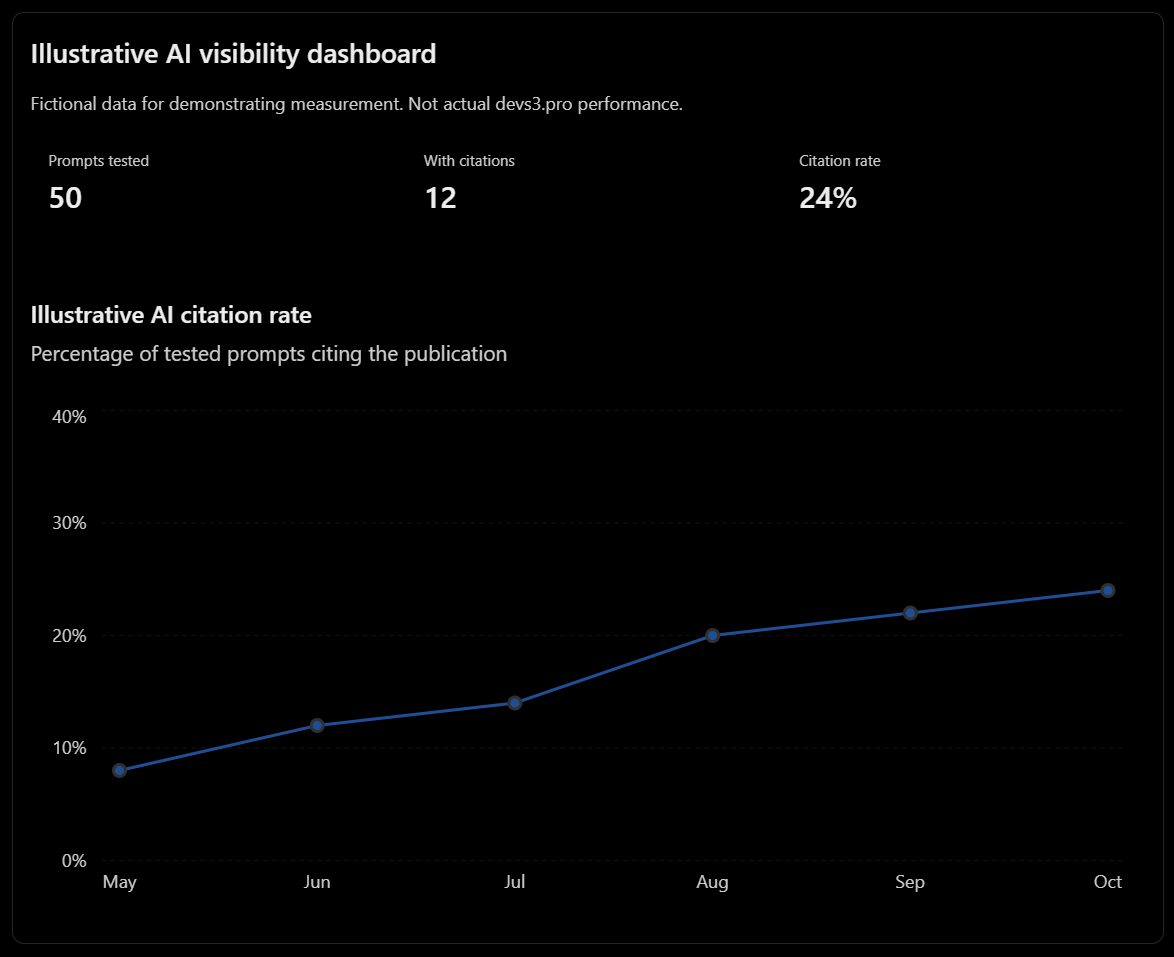
For example:
Important measurement limitations
AI responses can vary even when the prompt stays identical.
Results may depend on geography, user context, model version, available search indexes, and retrieval decisions.
A citation rate measured using a fixed test set is useful for tracking changes, but it is not the same as a universal AI ranking.
11. Common Optimization Mistakes to Avoid
Mistake 1: Assuming SEO is dead
SEO remains foundational because search engines still need to discover, evaluate, and surface web content.
AI search has expanded the discovery landscape rather than eliminating conventional search.
Mistake 2: Publishing AI-generated content without verification
AI-assisted writing can help with research organization and drafting.
However, inaccurate technical instructions, fabricated citations, and generic recycled content can harm credibility.
Human review and testing are especially important for code, cybersecurity, cloud infrastructure, and performance benchmarks.
Mistake 3: Believing schema markup guarantees AI visibility
Structured data can improve machine interpretation and support certain search features.
It does not force ChatGPT, Gemini, or Perplexity to cite or recommend a website.
Mistake 4: Treating GEO and LLMO as proven ranking formulas
No publicly documented universal algorithm determines how every generative engine selects citations or brands.
Beware of agencies promising guaranteed placements in AI-generated responses.
Mistake 5: Ignoring user intent
An article optimized for a keyword but failing to answer the reader's actual question is unlikely to create lasting value.
The priority should always be solving the user's problem accurately and efficiently.
Mistake 6: Over-optimizing for machines
Repeating definitions, adding excessive FAQ sections, and inserting unnatural keywords can make an article worse for readers.
Clear, useful writing serves both human audiences and machine-based discovery.
12. A Practical 90-Day Implementation Roadmap
For a technology publication such as devs3.pro, a phased strategy is more manageable than trying to optimize every page immediately.
01–30
Days
Phase 1: SEO and technical foundations
Audit indexing, crawlability, page titles, internal links, article structure, author information, and performance. Select 10 high-value evergreen articles for improvement.
31–60
Days
Phase 2: AEO and GEO improvements
Add concise definitions, comparison tables, accurate FAQs, original examples, citations, and version-specific technical guidance. Begin a repeatable AI citation audit.
61–90
Days
Phase 3: AIO, LLMO, and measurement
Improve entity consistency, validate structured data, build topic clusters, evaluate crawler access, review AI citations, and compare organic engagement and conversion metrics.
At the end of 90 days, evaluate which improvements correspond with better search visibility, qualified traffic, and accurate AI references.
Avoid attributing every change to a single optimization technique without supporting evidence.
13. Frequently Asked Questions
Is GEO replacing SEO?
No. GEO extends optimization into AI-generated search experiences. Traditional SEO remains important for search discovery, crawlability, content relevance, and organic traffic.
Which is more important: SEO or AEO?
Both are useful. SEO addresses broader search visibility, while AEO focuses on clear answers. Most informational websites benefit from implementing both together.
Is AIO the same as GEO?
Not necessarily. Some marketers use the terms interchangeably. AIO can refer more broadly to AI-readiness and AI-assisted optimization, while GEO usually emphasizes visibility in generative answers.
Can I optimize my website for ChatGPT?
You can improve public content quality, accessibility, factual clarity, and search discoverability. Where relevant, you can also review OpenAI's published crawler guidance. However, you cannot guarantee that ChatGPT will retrieve, cite, or recommend your website.
Does adding structured data improve AI citations?
Structured data can help systems interpret page information, but it does not guarantee AI citations. Its impact depends on the system, content, and retrieval process.
Can LLMO influence model training?
Website content may be included in future training datasets under applicable collection policies, but publishers generally cannot control whether a specific model learns or retains particular facts. Retrieval-based discoverability is a more observable optimization target.
What is the best strategy for a new technology blog?
Start with technical SEO, original tutorials, accurate examples, clear answer sections, and trustworthy references. Then measure AI search visibility and expand your content clusters based on genuine reader needs.
14. The Future of Search Optimization
Search optimization is moving toward a more diverse discovery ecosystem.
Users may continue using conventional search engines for navigation and research while relying on AI assistants for comparisons, troubleshooting, recommendations, and complex questions.
That means publishers increasingly need to optimize for multiple forms of visibility.
A useful way to think about the five approaches is:
SEO
Be discoverable
Help search engines find and rank your content.
AEO
Be answerable
Make important answers clear and easy to locate.
GEO
Be citable
Publish evidence-based information useful in AI answers.
AIO
Be machine-readable
Make content and technical systems accessible.
LLMO
Be understandable and trustworthy
Build consistent entity identity and a credible reputation.
The most sustainable approach is not to chase every new acronym independently.
Instead, create information that is accurate, original, technically accessible, well-organized, and genuinely useful.
Those qualities support both traditional search visibility and emerging AI discovery experiences.
Conclusion
SEO, AEO, GEO, AIO, and LLMO represent overlapping approaches to a rapidly changing information discovery landscape.
SEO remains essential for organic search. AEO helps content answer questions directly. GEO focuses on visibility and citations in generative responses. AIO emphasizes machine accessibility and AI-oriented optimization. LLMO considers how entities and brands are understood and represented in language-model experiences.
For businesses, developers, and technical publishers, the strongest strategy combines these approaches rather than treating them as competing alternatives.
The future of search optimization is not simply about ranking first. It is about becoming a reliable source of information wherever people — or AI systems assisting them — look for answers.