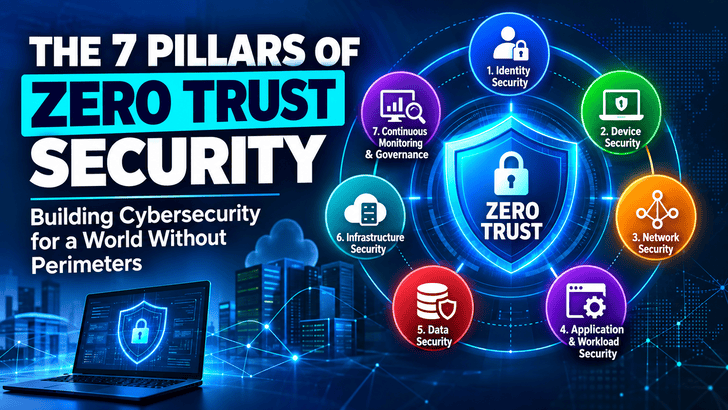
Meta Description: Learn the seven pillars of Zero Trust Security and how identity, devices, networks, applications, data, infrastructure, and continuous monitoring work together to protect modern organizations.
Cybersecurity used to revolve around a relatively simple idea: build a strong perimeter, keep attackers outside it, and trust the people and systems operating inside.
That model no longer fits the way modern technology works.
Organizations now run applications across public clouds, private clouds, SaaS platforms, data centers, employee laptops, mobile devices, APIs, containers, and remote environments. Employees may connect from anywhere, while customers, contractors, automated services, and machines all need different levels of access.
Join the conversation
Comments
No comments yet. Start the conversation.
The result is an environment where the traditional distinction between “inside” and “outside” the network has become far less useful.
This is where Zero Trust Security comes in.
At its core, Zero Trust follows a straightforward principle:
Never trust, always verify.
But Zero Trust is much more than adding multi-factor authentication or purchasing a Zero Trust Network Access product. It is a security architecture built around continuously evaluating identity, devices, applications, workloads, networks, data, and behavior.
In this article, we'll explore the seven pillars of Zero Trust Security, how they work together, and how organizations can begin implementing Zero Trust without rebuilding their entire infrastructure overnight.
What Is Zero Trust Security?
Zero Trust is a cybersecurity approach in which no user, device, workload, or connection receives implicit trust simply because of its location.
Instead, access decisions are based on context.
Before allowing access, a Zero Trust architecture may consider factors such as:
Who is requesting access?
Is the identity strongly authenticated?
Is the device known and secure?
What resource is being requested?
Does this user actually need access to it?
Where is the request coming from?
Is the behavior consistent with previous activity?
Has the security posture changed since authentication?
The important difference is that verification doesn't necessarily end after login.
Authentication, authorization, device posture, telemetry, and risk can continue to influence access throughout a session.
This leads to several fundamental Zero Trust principles:
Together, these principles create a fundamentally different security model.
The 7 Pillars of Zero Trust Security
Although Zero Trust frameworks can categorize capabilities differently, a practical architecture can be understood through seven closely connected pillars.
1. Identity Security
Identity sits at the center of Zero Trust.
Before deciding whether someone can access a system, an organization first needs confidence about who—or what—is requesting access.
Identity security therefore extends well beyond usernames and passwords.
Important capabilities include:
Identity and Access Management (IAM)
Multi-Factor Authentication (MFA)
Single Sign-On (SSO)
Identity governance
Privileged Access Management
Risk-based authentication
Conditional access
Role- and attribute-based authorization
Consider an administrator trying to access a production database.
In a traditional environment, being connected to the corporate VPN might have been sufficient.
Under Zero Trust, the system could evaluate the administrator's identity, MFA status, device health, location, requested resource, privilege level, and current risk signals before granting access.
And even when access is granted, it should be only the access necessary to perform the task.
Identity is no longer just about humans
Modern systems also contain enormous numbers of machine identities:
APIs
Containers
Microservices
CI/CD pipelines
Service accounts
Serverless functions
Kubernetes workloads
Securing these identities is equally important.
A compromised service account with excessive privileges can be just as dangerous as a compromised administrator account.
2. Device Security
A valid identity does not automatically mean a trustworthy device.
Imagine an employee successfully completing MFA from a laptop infected with malware.
Identity verification succeeded—but granting unrestricted access could still expose sensitive resources.
Zero Trust therefore evaluates the security posture of endpoints.
This may involve:
Endpoint Detection and Response (EDR)
Mobile Device Management (MDM)
Device certificates
Patch status
Disk encryption
Secure configuration
Malware detection
OS version checks
Endpoint compliance policies
A healthy corporate laptop, for example, might receive normal access.
An unmanaged device could receive restricted access, while a compromised endpoint could be denied completely.
The important concept is:
Authenticate the user and evaluate the device.
Both contribute to the final access decision.
3. Network Security
Traditional networks often provide too much trust after a user gets inside.
An attacker who compromises one endpoint may attempt to move laterally through the environment until they reach more valuable systems.
Zero Trust networks are designed to make that significantly harder.
Key technologies include:
Zero Trust Network Access (ZTNA) — provides controlled access to specific applications instead of broad network-level access.
Microsegmentation — divides infrastructure into smaller security zones and tightly controls communication between them.
Encrypted traffic — protects communications between users, applications, services, and workloads.
Network monitoring — continuously analyzes communication patterns for suspicious activity.
Secure DNS — helps prevent connections to malicious infrastructure.
A developer who needs access to a source-code repository, for example, should not automatically gain network access to payroll databases simply because both resources exist inside the same corporate environment.
Zero Trust replaces broad connectivity with specific, policy-driven access.
4. Application and Workload Security
Applications are among the most valuable targets in modern infrastructure.
Zero Trust therefore needs to extend throughout the software lifecycle—from development to production.
Important controls include:
Secure Software Development Lifecycle (SSDLC)
API security
Dependency and vulnerability scanning
Code scanning
Runtime protection
Secrets management
Workload identity
Container security
Kubernetes security
This becomes especially important with microservices.
Suppose an application contains:
text
Frontend
   ↓
API Gateway
   ↓
User Service
   ↓
Payment Service
   ↓
Database
A traditional internal network might allow relatively broad communication between these components.
A Zero Trust architecture treats every connection as something that should be authenticated and authorized.
The frontend shouldn't automatically communicate directly with the payment database.
The User Service shouldn't automatically inherit Payment Service privileges.
Each workload receives only the permissions it requires.
This dramatically reduces the potential blast radius if one application component is compromised.
5. Data Security
Ultimately, cybersecurity exists to protect something—and very often that something is data.
Zero Trust therefore requires organizations to understand:
What data do we have, where is it stored, who can access it, and what happens when someone tries to move it?
Controls may include:
Data classification
Encryption at rest and in transit
Data Loss Prevention (DLP)
Database security
Key management
Access controls
Backup and recovery
Data monitoring
Not all information should receive identical treatment.
A public product brochure doesn't require the same security controls as:
text
Customer payment information
Employee records
Production credentials
Source code
Encryption keys
Medical information
Financial records
Data classification allows security policies to reflect those differences.
Zero Trust aims to ensure that sensitive data remains protected even when another part of the environment is compromised.
6. Infrastructure Security
Modern infrastructure extends far beyond physical servers.
Organizations now operate combinations of:
AWS, Azure, and Google Cloud
Virtual machines
Containers
Kubernetes
Serverless platforms
On-premises infrastructure
SaaS services
Infrastructure as Code
Each layer introduces configurations, permissions, workloads, and potential attack paths.
Infrastructure-focused Zero Trust controls can include:
Cloud Security Posture Management (CSPM)
Workload protection
Infrastructure compliance
Configuration monitoring
Vulnerability management
Cloud IAM controls
Runtime security
Misconfiguration is particularly important in cloud environments.
A storage bucket, database, security group, IAM role, or API can become exposed through a relatively small configuration mistake.
Infrastructure security therefore needs to be continuous rather than limited to occasional audits.
7. Continuous Monitoring, Analytics, and Governance
The previous six pillars generate enormous amounts of security information.
Zero Trust becomes substantially more powerful when those signals are brought together.
Continuous monitoring can include technologies such as:
Security Information and Event Management (SIEM)
Extended Detection and Response (XDR)
User and Entity Behavior Analytics (UEBA)
Threat intelligence
Security analytics
Automated detection and response
Policy compliance and auditing
Consider a user who normally logs in from one country during regular working hours.
Suddenly, the account:
Logs in from an unusual location.
Attempts to access sensitive infrastructure.
Downloads an unusually large amount of information.
Tries to elevate privileges.
Each event individually might not prove an attack.
Together, they represent a much stronger risk signal.
A mature Zero Trust environment can use that information to require additional authentication, restrict access, terminate a session, isolate an endpoint, or alert security teams.
This is why Zero Trust is continuous, rather than a one-time authentication event.
How the Seven Pillars Work Together
The real strength of Zero Trust appears when the pillars exchange context.
Imagine an engineer requesting access to a production Kubernetes cluster.
Step 1: Verify identity
The engineer authenticates using SSO and phishing-resistant MFA.
Step 2: Evaluate the device
The endpoint must satisfy organizational requirements such as encryption, endpoint protection, and current security updates.
Step 3: Evaluate context
The system checks location, behavior, session risk, and other available signals.
Step 4: Apply least privilege
The engineer receives only the Kubernetes permissions required for their role.
Step 5: Protect network access
ZTNA provides access specifically to the required management interface instead of exposing the wider production network.
Step 6: Protect workloads and data
Workload policies restrict which services and databases the engineer can interact with.
Step 7: Monitor continuously
SIEM/XDR platforms analyze activity and flag abnormal behavior.
The result isn't a single security control.
It is a chain of verification and enforcement mechanisms.
Zero Trust vs. Traditional Perimeter Security
Traditional Security
Zero Trust Security
Trust internal networks
Trust is never implicit
VPN often provides broad network access
ZTNA provides application-specific access
Authentication mainly happens at login
Risk can be evaluated continuously
Network location influences trust
Identity and context influence access
Large network zones
Microsegmented environments
Broad permissions
Least privilege
Focus on preventing intrusion
Assume compromise is possible
Periodic security checks
Continuous monitoring
This does not mean firewalls, VPNs, or perimeter defenses suddenly become useless.
Rather, Zero Trust assumes perimeter controls alone cannot provide sufficient protection.
Zero Trust and the Cloud
Cloud computing is one of the strongest reasons organizations are adopting Zero Trust architectures.
There is no single perimeter surrounding all of these relationships.
Zero Trust provides a more suitable model by making identity, context, policy, and resource sensitivity central to access decisions.
This is especially valuable for hybrid and multi-cloud architectures.
Zero Trust, ZTNA, and SASE: What's the Difference?
These terms are sometimes used interchangeably, but they describe different things.
Zero Trust is the overall security philosophy and architectural model.
ZTNA (Zero Trust Network Access) is a technology used to provide controlled access to specific applications and resources based on identity and policy.
SASE (Secure Access Service Edge) combines networking and security capabilities—often including technologies such as ZTNA, secure web gateways, CASB, and SD-WAN—into a cloud-delivered architecture.
ZTNA can therefore be an important component of Zero Trust, but installing a ZTNA product alone does not create a complete Zero Trust architecture.
AI's Growing Role in Zero Trust
Modern organizations generate far more security telemetry than humans can manually analyze.
AI and machine learning can help identify patterns across authentication, endpoint, network, cloud, and application activity.
Potential uses include:
Detecting anomalous user behavior
Identifying suspicious login patterns
Prioritizing security alerts
Detecting compromised endpoints
Calculating dynamic risk
Finding unusual data transfers
Automating incident response
For example, an access system could combine several signals:
text
Known user
+ Unknown device
+ Unusual location
+ Sensitive application
+ Abnormal behavior
= High-risk request
The system could then request stronger authentication or deny the request entirely.
AI, however, should enhance—not replace—well-designed access policies, strong authentication, logging, segmentation, and security governance.
How to Start Implementing Zero Trust
Organizations don't need to transform everything simultaneously.
A practical implementation can begin with a few high-value steps:
Inventory identities, devices, applications, workloads, and sensitive data.
Deploy strong MFA, particularly for privileged and high-risk accounts.
Remove unnecessary privileges and adopt least-privilege access.
Strengthen endpoint security with device compliance and EDR.
Replace unnecessarily broad remote access with application-specific access where appropriate.
Segment critical workloads to reduce lateral movement.
Secure APIs and machine identities alongside human identities.
Centralize security telemetry through SIEM, XDR, or equivalent platforms.
Continuously evaluate policies instead of treating Zero Trust as a one-time project.
A useful rule is to start with the organization's most valuable assets and highest-risk access paths.
Protect those first, measure the results, and expand gradually.
Common Zero Trust Mistakes
One of the biggest mistakes is treating Zero Trust as a product.
There is no single appliance or software platform that can magically make an organization "Zero Trust."
Another mistake is implementing excessive controls without considering usability. If security creates too much friction, users may look for ways around it.
Organizations should also avoid focusing exclusively on employees. Service accounts, APIs, automation pipelines, containers, and workloads increasingly represent critical identities.
Finally, collecting security telemetry without having the ability to analyze or respond to it provides limited value.
Successful Zero Trust programs combine technology, policy, visibility, automation, and operational processes.
The Future of Zero Trust Security
Zero Trust is becoming increasingly relevant as infrastructure becomes more distributed.
Cloud adoption, remote work, SaaS applications, APIs, edge computing, containers, AI systems, and machine identities are making traditional network boundaries increasingly difficult to define.
Future Zero Trust architectures are therefore likely to become more:
Identity-centric, with stronger authentication and machine identity management.
Context-aware, using richer device, location, workload, and behavioral signals.
Automated, with policies changing dynamically according to risk.
Data-centric, protecting information regardless of where it is stored.
AI-assisted, helping security teams analyze enormous volumes of telemetry.
But the central idea will remain remarkably simple:
Trust should never be assumed. It should be continuously earned and verified.
Conclusion
Zero Trust represents a fundamental shift in cybersecurity thinking.
Instead of asking:
"Is this user inside our network?"
organizations increasingly need to ask:
"Who is requesting access, from what device, to which resource, under what conditions, and should we trust this specific request right now?"
The seven pillars—Identity Security, Device Security, Network Security, Application & Workload Security, Data Security, Infrastructure Security, and Continuous Monitoring & Governance—provide a useful framework for answering those questions.
Zero Trust doesn't mean blocking everything.
It means providing the right access, to the right resource, for the right identity, from an acceptable device, under the right conditions—and continuously verifying that decision.
For developers, DevOps engineers, cloud architects, and security teams, that makes Zero Trust much more than another cybersecurity trend.
It is increasingly becoming an architectural foundation for securing modern digital infrastructure.