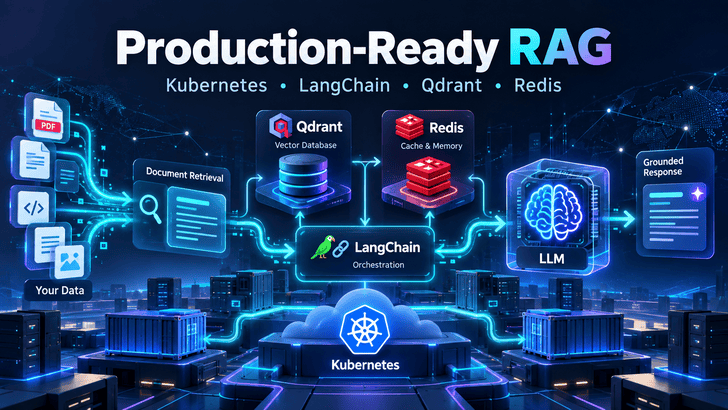
Retrieval-Augmented Generation (RAG) has quickly become one of the most important architectural patterns in modern AI engineering.
A simple RAG demo can be built in a few hours: upload some documents, generate embeddings, store them in a vector database, retrieve relevant chunks, and send the resulting context to a Large Language Model (LLM).
Production is a completely different challenge.
Once hundreds or thousands of users start sending requests, engineers need to think about scalability, caching, observability, document ingestion, failures, security, autoscaling, state management, deployment, and cost.
This is where technologies such as Kubernetes, LangChain, Qdrant, Redis, HPA, and LLM APIs can work together to create a scalable AI platform.
This article explores how these components fit into a production-ready RAG architecture.
This approach allows organizations to build AI applications around private or frequently changing information without retraining an entire language model.
Common examples include:
Enterprise knowledge assistants
Documentation chatbots
Customer-support assistants
Internal knowledge search
Research platforms
AI agents
Document Q&A systems
Multi-tenant AI platforms
The Production RAG Technology Stack
A practical cloud-native RAG platform might contain the following components:
Each component solves a different production problem.
1. Kubernetes: The Infrastructure Layer
Kubernetes provides the orchestration layer for the application.
Instead of running the RAG API as a single server, Kubernetes allows multiple application instances to run as containers.
For example:
text
Kubernetes Cluster

├── Ingress Controller
├── RAG API Deployment
│   ├── API Pod 1
│   ├── API Pod 2
│   └── API Pod 3
│
├── Background Workers
│   ├── Ingestion Worker
│   ├── Embedding Worker
│   └── Cleanup Worker
│
├── Redis
├── Qdrant
└── Monitoring Stack
Kubernetes provides capabilities such as:
Service discovery
Rolling deployments
Self-healing
Load balancing
Horizontal scaling
Resource limits
Configuration management
Secret management
The RAG application itself should ideally remain mostly stateless. Persistent information should live in external systems such as Redis, Qdrant, object storage, or a relational database.
That makes application pods much easier to scale horizontally.
2. LangChain: The AI Application Layer
LangChain can provide the orchestration logic between the application, retrieval system, tools, memory, and LLM.
The application might use LangChain components such as:
Metadata filtering becomes particularly important when building enterprise and multi-tenant RAG platforms.
4. Redis: Caching and Short-Term Memory
Calling embedding models, vector databases, and LLM APIs for every request can become expensive.
Redis can significantly reduce unnecessary work.
It can be used for:
Query caching
Response caching
Session state
Conversation memory
Rate limiting
Distributed locks
Temporary workflow state
For example:
text
User Query
    ↓
Redis Cache
   / \
 HIT  MISS
 │      │
 ▼      ▼
Return  Run RAG Pipeline
Cache   ↓
        Store Result
        ↓
        Return Response
Caching can improve response times while reducing LLM and infrastructure costs.
However, cache design requires special care in multi-tenant environments.
A cache key should potentially account for:
text
Tenant
User permissions
Document version
Model
Prompt version
Query
Otherwise, cached content could become stale—or worse, information intended for one tenant could accidentally become accessible to another.
5. The Complete RAG Request Flow
Now we can combine everything.
A typical production request might follow this path:
text
1. User sends question

2. Kubernetes Ingress receives request

3. Request is routed to an available API pod

4. Application authenticates the user

5. Redis is checked for an appropriate cached result

6. Query embedding is generated

7. Qdrant performs semantic retrieval

8. Permission/metadata filters are applied

9. Relevant document chunks are returned

10. LangChain builds the prompt

11. Prompt and retrieved context are sent to the LLM

12. LLM generates the response

13. Response may be stored in Redis

14. API returns the result to the user
The important point is that the LLM represents only one component of the system.
A reliable production AI platform requires an entire infrastructure surrounding it.
Document Ingestion Architecture
RAG has another major pipeline that is sometimes overlooked: document ingestion.
Before users can retrieve documents, those documents must be processed.
That difference is why deploying generative AI is increasingly becoming an infrastructure and platform-engineering problem—not simply a prompt-engineering problem.
Final Thoughts
Building a RAG demo is relatively easy. Building a RAG platform that remains fast, secure, observable, cost-efficient, and reliable under production traffic requires much more engineering.
Kubernetes provides orchestration and scalability.
LangChain coordinates retrieval and LLM workflows.
Qdrant provides semantic vector search.
Redis provides fast caching and temporary state.
HPA dynamically adjusts compute capacity.
LLMs provide the reasoning and generation layer.
Together, these technologies provide a strong foundation for cloud-native RAG systems.
The key architectural lesson is simple:
The LLM is not the entire AI application.
Production AI requires a complete platform around the model—covering retrieval, caching, state management, scaling, security, observability, data ingestion, and deployment.
As organizations move from AI experiments toward real enterprise applications, understanding this full architecture will become an increasingly valuable skill for AI engineers, DevOps engineers, SREs, cloud engineers, and platform teams.