Loading…
Top 10 Business Ideas for 2027: High-Growth Opportunities for the AI-Driven Economy · devs3
Skip to content The business landscape entering 2027 will look very different from the one entrepreneurs faced only a few years ago.
Artificial intelligence is moving beyond chatbots and content generation into autonomous agents, computer vision, cybersecurity, healthcare, financial management, advertising, education, energy, and physical infrastructure. At the same time, businesses are becoming increasingly interested in automation, first-party data, recurring SaaS platforms, and technologies that connect the physical and digital worlds.
For entrepreneurs, the biggest opportunities may therefore not come from simply creating another AI application. They are more likely to come from combining AI with a specific industry, workflow, dataset, or physical infrastructure .
A strong business for 2027 should ideally have several characteristics:
A large or rapidly growing market
Recurring revenue potential
A clear business problem to solve
Opportunities to use AI or automation
Proprietary data or another competitive advantage
The ability to expand internationally
High customer retention once integrated into business operations
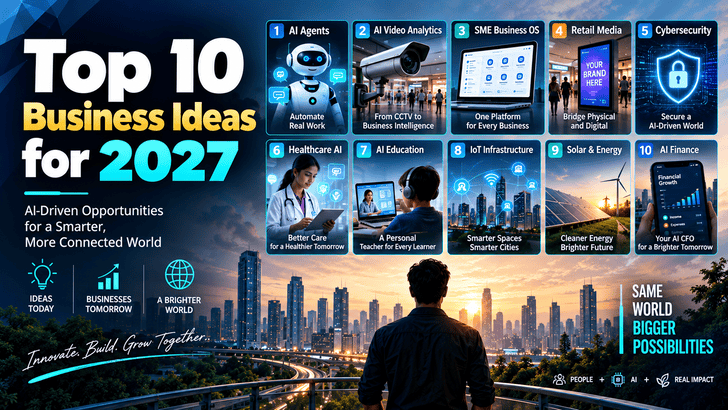
Based on these principles, here are ten business opportunities that could become particularly attractive in 2027 and beyond.
1. Vertical AI Agent SaaS One of the biggest opportunities for 2027 could be the emergence of industry-specific AI agents .
The first generation of generative AI primarily helped people answer questions, generate text, write code, summarize documents, and create content.
The next generation is increasingly focused on performing actual work.
Instead of asking:
"How should I respond to this customer?"
an AI system may eventually identify the customer request, check company records, prepare the appropriate response, update the CRM, create a support ticket if necessary, and schedule a follow-up automatically.
This creates an enormous opportunity for Vertical AI SaaS.
What Is Vertical AI? Vertical AI is artificial intelligence designed specifically for one industry or business function.
Examples include:
More from this author recent popular
Join the conversation
👍 0 👎 0 ☆ Save Add to Reading list
Comments Add a comment Post comment
No comments yet. Start the conversation.
AI receptionist for clinics
AI customer-support agent for ISPs
AI campaign manager for advertising agencies
AI sales assistant for retailers
AI accounting assistant for SMEs
AI property-management assistant
Instead of trying to create one AI capable of doing everything, the product becomes exceptionally good at performing a particular set of tasks.
Example: AI Agent for Clinics A clinic AI agent could manage:
Human employees would remain responsible for sensitive decisions, while repetitive administrative work could increasingly be automated.
Business Model Possible pricing models include:
$20–$500+ per organization depending on functionality and market.
Charge based on AI conversations, calls, transactions, documents, or automated tasks.
Large organizations could receive private deployments, custom integrations, security controls, and dedicated infrastructure.
Why It Could Be Huge Once an AI agent becomes deeply integrated into a company's operations, replacing it becomes difficult.
That creates strong customer retention.
The real competitive advantage may therefore not be the underlying AI model. It will often be:
Industry knowledge + workflow integration + proprietary data + automation.
2. AI Video Analytics and Smart CCTV Millions of CCTV cameras are installed around the world primarily for security.
But most of those cameras simply record video.
That means an enormous amount of potentially useful business information remains unused.
Computer vision can transform cameras from passive recording devices into intelligent business sensors.
From CCTV to Business Intelligence A modern AI camera system could analyze:
Number of visitors
Unique visitors
Returning visitors
Customer movement
Dwell time
Queue length
Occupancy
Customer demographics
Approximate age groups
Customer engagement
Store heatmaps
Staff activity
Unusual events
The system could then combine camera analytics with POS transactions.
The platform can calculate an approximate:
23% visitor-to-purchase conversion rate.
That is significantly more useful than simply recording CCTV footage.
Customer Journey Analytics Advanced systems could estimate:
Entrance → Product Area → Product Interaction → Checkout → Exit
Businesses could discover where customers spend the most time and which sections receive little attention.
AI Recommendations The most valuable layer could eventually be AI-generated recommendations.
Customer traffic increased 18% this week, but sales increased only 4%. Checkout queues were significantly longer between 6 PM and 8 PM.
Customers who visited Display Zone B had a higher conversion rate. Consider testing similar product placement in Zone C.
The platform therefore evolves from a surveillance system into a Retail Intelligence Platform .
Target Customers Potential customers include:
Supermarkets
Restaurants
Shopping malls
Retail stores
Factories
Offices
Banks
Hospitals
Airports
Universities
Business Model A particularly attractive model could combine:
Hardware + installation + SaaS subscription
Recurring revenue makes this considerably more attractive than a traditional CCTV installation company.
3. SME Business Operating System Small businesses often use several disconnected tools.
One system handles accounting.
Another manages inventory.
Another handles employees.
Another manages customers.
Some businesses still rely heavily on spreadsheets, messaging apps, notebooks, and paper records.
This creates an opportunity for an integrated SME Business Operating System .
The Platform A complete platform could include:
Instead of switching between several applications, the owner operates the entire business from one platform.
Don't Start With Every Industry Trying to serve every type of business immediately would be a mistake.
A stronger strategy is to dominate one vertical first.
Business OS for Pharmacies
Restaurants
Grocery stores
Electronics retailers
Fashion retailers
Distributors
Clinics
AI Business Assistant The AI layer could allow an owner to ask:
Why did profit decrease this month?
The system could analyze:
Sales
and generate an explanation.
Eventually, every small business could have something resembling an AI business manager .
4. Retail Media and Next-Generation AdTech Digital advertising has traditionally been dominated by websites, search engines, social platforms, and mobile applications.
But advertising is expanding into physical environments.
This creates an opportunity around Retail Media Networks and omnichannel advertising infrastructure.
What Is Retail Media? Retail media allows advertisers to reach customers using advertising inventory and first-party data controlled by retailers or physical networks.
Potential inventory includes:
Store displays
Wi-Fi captive portals
Mobile apps
Websites
Digital signage
Smart TVs
POS displays
Interactive kiosks
These environments could eventually connect to a common advertising platform.
The Opportunity Imagine an advertising infrastructure connecting:
Advertisers could create one campaign and distribute it across multiple channels.
The architecture could include:
Advertiser → DSP → Ad Exchange → SSP → Digital Inventory
AI could automatically optimize campaigns based on:
CPM
CPC
Conversion
Location
Audience
Device
Time
Historical performance
Physical + Digital Advertising An especially interesting opportunity is connecting physical customer behavior with digital advertising.
For example, privacy-preserving aggregated analytics could show that a campaign increased visits to certain locations.
This could create new forms of advertising attribution without relying entirely on traditional browser cookies.
Revenue Model Potential revenue sources include:
AdTech businesses become particularly powerful when they control both technology and unique inventory .
5. Cybersecurity-as-a-Service for SMEs Cybersecurity is becoming more difficult as businesses adopt cloud infrastructure, remote work, APIs, IoT devices, and AI systems.
Large companies can employ dedicated security teams.
Small businesses often cannot.
This creates a growing opportunity for Cybersecurity-as-a-Service .
Possible Services A unified security platform could provide:
AI Creates a New Security Market AI agents create another security problem.
Organizations will need to answer questions such as:
Which AI agent can access customer records?
Can the agent send emails?
Can it approve transactions?
Can it access production servers?
Who authorized an action?
This could create an entirely new category:
AI Agent Identity and Security Management.
A platform could manage permissions, credentials, activity logs, approvals, and risk controls for autonomous AI systems.
Business Model Cybersecurity is well suited to recurring subscriptions because protection must remain continuously active.
Per user
6. Healthcare SaaS + AI Healthcare remains one of the world's largest industries, yet many healthcare workflows remain fragmented.
Patients may have records in different hospitals, clinics, diagnostic centers, and pharmacies.
Doctors frequently have incomplete information.
Healthcare SaaS could connect these systems.
Healthcare Ecosystem A platform could connect:
Patient ↔ Doctor ↔ Clinic ↔ Hospital ↔ Diagnostic Center ↔ Pharmacy
Core features could include:
Patient records
Appointments
Doctor scheduling
Electronic prescriptions
Diagnostic reports
Billing
Pharmacy integration
Patient history
Medical-document storage
Consent management
Analytics
Patient-Controlled Medical Records An important architecture would allow patients to control which organizations can access particular medical information.
For example, a patient could authorize Doctor B to access records previously generated by Clinic A.
This could create a more interoperable healthcare ecosystem.
AI Opportunities Medical documentation
Appointment scheduling
Report summarization
Administrative workflows
Patient communication
Operational analytics
Resource planning
Clinical decisions should retain appropriate professional oversight, but enormous portions of healthcare administration can be automated.
Revenue Possible revenue models include:
doctor subscriptions
transaction fees
enterprise licensing
integrations.
7. AI-Powered Education and Skills Platform Traditional online education usually gives every student approximately the same material.
AI makes something different possible:
A personalized teacher for every student.
AI Personal Teacher The platform could understand:
What the learner already knows
What the learner struggles with
How quickly the learner progresses
Which teaching format works best
Which lessons should come next
It could then dynamically generate a learning path.
Possible Markets The same technology could eventually serve:
Children
School students
University students
Professionals
Job seekers
English
Local-Language Opportunity Many major AI education products are still primarily optimized around globally dominant languages.
Creating excellent educational experiences for Bangla and other underserved languages could create a defensible regional opportunity.
Business Model A freemium model could work particularly well:
advertising
premium AI tutor
certificates
institutional plans.
Schools and companies could also purchase organizational subscriptions.
8. IoT and Smart Infrastructure Platform Billions of physical devices are gradually becoming connected.
But installing sensors is only the first step.
The larger opportunity is creating the software platform that manages them.
Smart Infrastructure Platform A unified IoT platform could manage:
Wi-Fi infrastructure
Smart meters
CCTV
Environmental sensors
Access control
Vehicle tracking
Asset tracking
Energy monitoring
Building systems
Everything could appear in one dashboard.
Target Markets Potential customers include:
Universities
Factories
Hospitals
Shopping malls
Apartment complexes
Hotels
Corporate offices
Municipal infrastructure
Digital Twin Eventually, businesses could create a digital representation of a physical property.
A building might appear digitally with:
Energy usage
AI could continuously analyze this information and recommend improvements.
That creates the foundation for a Smart Building OS or even a broader Smart Infrastructure OS .
9. Solar and AI Energy Management Renewable energy will remain a major business opportunity, but simply selling solar panels may become increasingly commoditized.
The more interesting opportunity is combining energy hardware with software.
Energy-as-a-Service A modern platform could integrate:
batteries
smart meters
IoT sensors
AI forecasting.
Electricity consumption
Solar generation
Battery status
Grid usage
Energy cost
Forecast consumption
Peak usage
AI recommendations
AI Energy Optimization AI could determine when to:
Charge batteries
For commercial customers, even small efficiency improvements can produce meaningful financial savings.
Target Customers Potential markets include:
Factories
Apartment buildings
Offices
Restaurants
Hotels
Telecom infrastructure
Data centers
Instead of selling equipment once, companies could offer Energy-as-a-Service with long-term recurring contracts.
10. AI-Powered Personal and SME Finance OS Expense trackers already exist.
Accounting software already exists.
The next opportunity is creating software that actually understands financial behavior.
Personal Finance OS Income
Expenses
Bills
Loans
Money lent to others
Savings
Family expenses
Subscriptions
Financial goals
Investments
Where did I overspend this month?
The AI could analyze transactions and explain the answer.
Can I afford a $1,000 purchase next month?
The system could forecast cash flow before answering.
AI CFO for Small Businesses The B2B opportunity may be even larger.
Revenue
A business owner could ask:
Why is my cash balance decreasing even though sales are increasing?
The AI could investigate the underlying data and explain the reason.
Eventually, sophisticated financial intelligence that was previously available mainly to large companies could become affordable for small businesses.
The Three Biggest Opportunities Although all ten categories are promising, three stand out particularly strongly.
1. Vertical AI Agents AI agents could become a new software layer across almost every industry.
The winners may not necessarily own the largest AI models. They may own the best industry workflows, integrations, and proprietary datasets .
2. AI Video Analytics Computer vision connects AI with the physical world.
Cameras can evolve from security devices into business-intelligence sensors.
Retail, manufacturing, transportation, hospitality, healthcare, and smart-city infrastructure could all benefit.
3. Retail Media and AdTech Companies possessing unique advertising inventory and first-party data could build powerful advertising ecosystems.
Combining digital advertising with physical environments creates an especially interesting long-term opportunity.
An Even Bigger Opportunity: Connecting Everything The most interesting strategy may not be building these businesses completely independently.
Several can eventually become components of a larger ecosystem.
Consider the following architecture:
Physical Infrastructure Layer
IP Cameras
Customer events
Computer Vision
Retail Analytics
Recommendations
The value becomes significantly greater when these systems can communicate.
A camera knows how many customers entered.
The POS knows how many purchased.
The advertising platform knows which campaigns were displayed.
The Wi-Fi platform understands aggregated connectivity patterns.
The inventory platform knows which products are selling.
AI can analyze all of them together.
Instead of selling individual software products, a company could eventually provide an AI-powered operating platform for physical businesses .
What Makes a Strong 2027 Startup? Technology alone will not determine the winners.
A successful startup should attempt to build at least one strong competitive moat.
That moat could come from:
Proprietary Data Data competitors cannot easily obtain.
Distribution Access to customers or physical locations that competitors cannot easily replicate.
Workflow Integration Software deeply embedded in daily business operations.
Network Effects The platform becomes more useful as more businesses, users, advertisers, or partners join.
Hardware + Software Integration Combining physical infrastructure with SaaS can make copying the product significantly harder.
Industry Expertise Understanding a specific industry better than generic technology companies.
What Should Entrepreneurs Avoid? The AI boom will also produce thousands of businesses with very little defensibility.
For example, simply putting a user interface around an existing AI API may not create a sustainable company.
If competitors can reproduce the product within a few days, pricing power will eventually disappear.
Entrepreneurs should instead ask:
What do we own that competitors cannot easily copy?
Or a combination of them.
Final Thoughts 2027 is unlikely to be simply "the year of AI."
A more accurate description may be:
The year AI becomes embedded inside real businesses.
The largest opportunities will increasingly emerge where artificial intelligence connects with real operational problems.
AI agents performing business workflows.
Computer vision understanding physical environments.
Cybersecurity protecting autonomous systems.
Healthcare platforms connecting fragmented information.
Education becoming personalized.
Energy becoming intelligent.
Advertising connecting physical and digital audiences.
And financial software evolving into automated financial intelligence.
Entrepreneurs therefore should not ask only:
"What AI product should I build?"
"Which expensive, repetitive, data-rich business problem can AI now solve dramatically better than before?"
That question can lead to much stronger companies.
The entrepreneurs who identify those problems early, build proprietary data and distribution advantages, and create recurring-revenue products around them could be among the companies defining the next decade.
Quick Ranking Rank
Business Idea
Startup Cost
Scalability
Recurring Revenue
Long-Term Potential
1
Vertical AI Agent SaaS
Medium
Very High
Very High
⭐⭐⭐⭐⭐
2
AI Video Analytics
Medium–High
Very High
Very High
⭐⭐⭐⭐⭐
3
SME Business OS
Medium
Very High
Very High
⭐⭐⭐⭐⭐
4
Retail Media / AdTech
High
Very High
Very High
⭐⭐⭐⭐⭐
5
Cybersecurity-as-a-Service
Medium
Very High
Very High
⭐⭐⭐⭐⭐
6
Healthcare SaaS + AI
Medium–High
Very High
Very High
⭐⭐⭐⭐½
7
AI Education Platform
Medium
Very High
High
⭐⭐⭐⭐½
8
IoT / Smart Infrastructure
High
High
High
⭐⭐⭐⭐½
9
AI Energy Management
High
High
High
⭐⭐⭐⭐
10
AI Finance OS / AI CFO
Medium
Very High
Very High
⭐⭐⭐⭐½
The common pattern across nearly all ten ideas is clear:
AI + proprietary data + industry expertise + recurring revenue + automation.
That combination is likely to be one of the most important formulas for building technology businesses in 2027 and beyond.