Introduction
If you are planning to build web applications, APIs, cloud services, or enterprise software, you will frequently hear one name: .NET.
.NET is a free, open-source, cross-platform development platform created by Microsoft. It allows developers to build applications that run on Windows, Linux, macOS, and even mobile and cloud environments.
In this article, you will learn:
What .NET really is
How .NET evolved over time
Why developers choose .NET in 2025
What types of applications you can build with it
This is Week 1 of our weekly .NET blog series. By the end of this series, you’ll be able to build and deploy production-ready .NET applications.
What Is .NET?
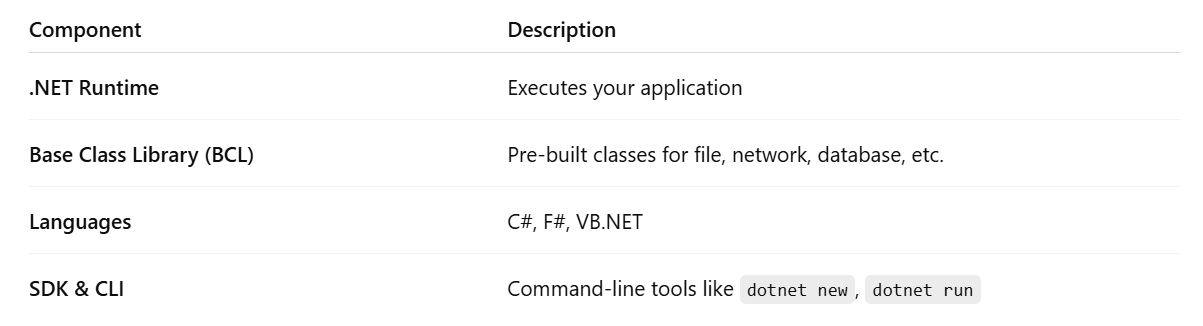
.NET is a developer platform that provides:
A runtime to execute applications
Libraries for common tasks
Languages like C#, F#, and VB.NET
Tools for building, testing, and deploying software
At its core, .NET helps developers write code once and run it anywhere.
Key Components of .NET
Evolution of .NET (Short History)
Understanding the evolution of .NET helps clear confusion many beginners have.
1️⃣ .NET Framework (2002)
Windows-only
Used mainly for desktop and enterprise apps
No longer actively developed
2️⃣ .NET Core (2016)
Cross-platform
High performance
Open source