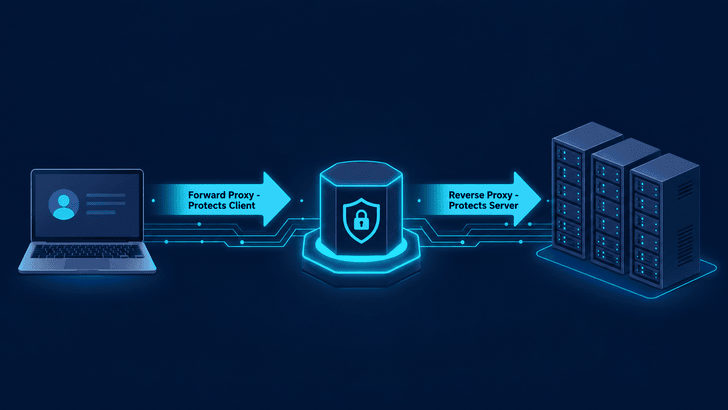
When I first started exploring enterprise application architecture, proxies seemed like abstract concepts—just another box in the network diagram. But once I dug deeper, I realized that forward and reverse proxies are fundamentally different tools, each solving distinct problems in how clients and servers communicate.
Let me break them down in a way that finally made it click for me.
The Core Distinction: Who's Being Protected?
The simplest way to understand the difference is this: a forward proxy protects the client, while a reverse proxy protects the server.
Everything else flows from that single principle.
Forward Proxy: Your Representative to the Outside World
Imagine you're in a large corporate office. You don't walk directly up to every external website yourself—instead, there's a designated intermediary that handles all outbound communication on behalf of everyone in the building.